
Capital Gains Tax on Investment Property:
The Complete 2026 Guide
How CGT is actually calculated on an Australian rental property using investment property calculator sale cost base, the 50% discount, a full worked example, and the 2027 law change every investor needs to know about.

Johan Petrovic
Property Investment Adviser · QPIA · 17 years in practice
Specialist in tax strategy for residential investors · Melbourne, VIC

Selling a rental property is one of the biggest financial events most Australian investors go through and one of the easiest places to overpay the ATO by thousands of dollars, simply because the cost base wasn’t calculated properly.
This guide walks through exactly how capital gains tax (CGT) is calculated on an investment property in Australia, what you can legally deduct before the tax office gets a cut, and a major law change confirmed for 2027 that changes the maths for anyone selling after that date.
Get your exact number first
Run your sale price and purchase details through the free calculator, then come back here to see how it was worked out.
How CGT Works on an Investment Property
Capital gains tax isn’t a separate tax in Australia. When you sell an investment property for more than its cost base, the profit, the capital gain, gets added to your assessable income for that financial year and taxed at your marginal rate.
STEP 1
Work out the capital gain
STEP 2
Apply the 50% CGT discount
STEP 3
Tax at your marginal rate
There’s no separate “CGT rate.” Someone on a 32.5% marginal rate and someone on a 45% marginal rate will pay very different amounts of tax on an identical capital gain which is why two investors selling the same property in the same suburb for the same price can end up with completely different tax bills.
Step 1: Calculate Your Cost Base (Where Most People Overpay)
The cost base isn’t just what you paid for the property. The ATO allows you to add several categories of costs, and missing these is the single most common reason investors overpay CGT.
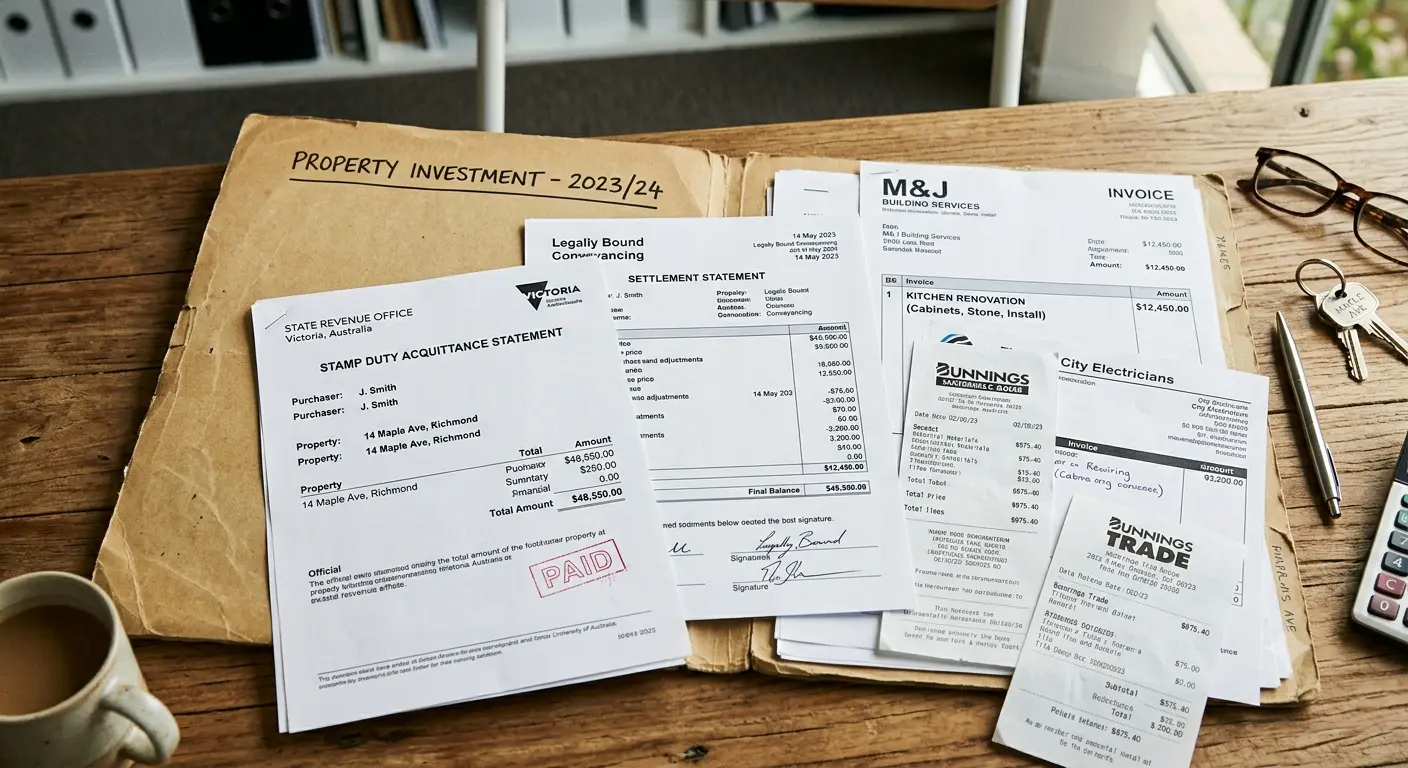
Your cost base generally includes:
- Purchase price of the property
- Stamp duty paid on purchase
- Legal fees for conveyancing, both on purchase and sale
- Agent’s commission on the sale
- Building and pest inspection costs
- Loan establishment fees (in some cases)
- Capital improvements — renovations, extensions, a new kitchen or bathroom (not repairs or maintenance, which are claimed as deductions elsewhere)
- Advertising costs for the sale
What you can’t include: Costs already claimed as an annual tax deduction (interest, council rates, property management fees) don’t count again here. Depreciation you’ve claimed actually reduces your cost base — which increases your taxable gain.
This is the step worth spending an hour on. A property bought for $600,000 with $25,000 in stamp duty, $40,000 in kitchen and bathroom renovations, and $18,000 in buying/selling costs has an $83,000 higher cost base than the purchase price alone which at a 37% marginal rate and with the 50% discount applied, is roughly $15,300 less tax owed.
Step 2: Apply the 50% CGT Discount
If you’re an Australian resident individual and you’ve owned the investment property for more than 12 months before selling, you only pay tax on half the capital gain.
Worked Example — 3 Year Hold | |
|---|---|
Cost base (purchase + costs) | $550,000 |
Sale price − selling costs | $820,000 |
Capital gain | $270,000 |
50% CGT discount (held 3 years) | − $135,000 |
Taxable capital gain | $135,000 |
This $135,000 is added to the owner’s other taxable income for the year and taxed at their marginal rate. If two people jointly own the property (say, a couple as tenants in common), the gain is split according to ownership share, and each person applies their own marginal rate to their portion often a much better outcome than one high-income earner holding 100%.
Step 3: Know What’s Coming — The 2027 CGT Changes
Here’s something most CGT calculators and guides online haven’t updated for yet, and it directly affects anyone planning to sell an investment property in the next couple of years.
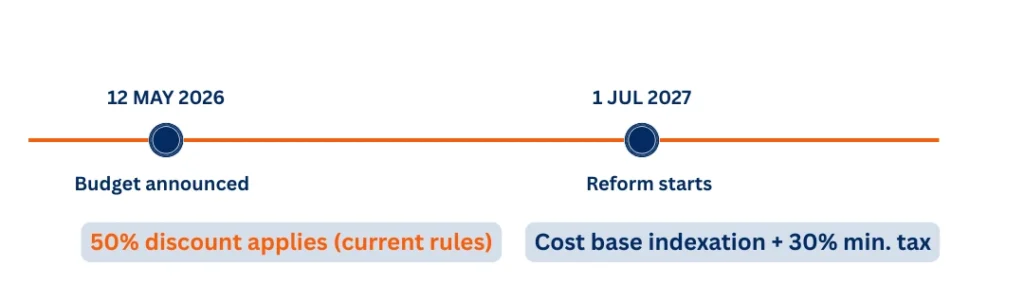
On 12 May 2026, as part of the 2026–27 Federal Budget, the Government announced it would reform negative gearing and capital gains tax arrangements. These measures are now law. From 1 July 2027, the 50% CGT discount for individuals, trusts and partnerships is replaced with cost base indexation and a 30% minimum tax rate on capital gains, and negative gearing for residential property is limited to new builds.
Selling before 1 July 2027
The current 50% discount rules in this guide still apply in full.
Selling after 1 July 2027
Only the gain that accrued after that date is taxed under the new rules. Gains built up before should still get the old 50% treatment.
Bought before 12 May 2026
Your negative gearing deductions aren’t affected by the new limits.
Because the transitional rules involve apportioning a gain across two different tax regimes based on when it “accrued,” anyone with a large unrealised gain approaching 2027 should get this modelled properly by a registered tax agent the difference between selling in June 2027 versus August 2027 could be significant.
How Much CGT Will I Actually Pay? A Full Worked Example
Let’s put it all together for a typical investor:
Sale Calculation — 7 Year Hold | |
|---|---|
Purchase price (2019) | $520,000 |
Stamp duty + legal fees | $23,000 |
Capital improvements (deck, reno) | $35,000 |
Cost base | $578,000 |
Sale price (2026) | $780,000 |
Selling costs (agent, legal) | $22,000 |
Net sale proceeds | $758,000 |
Capital gain | $180,000 |
50% CGT discount (held 7 years) | − $90,000 |
Taxable capital gain | $90,000 |
If this investor’s other taxable income is $95,000, adding $90,000 pushes a portion of the gain into the 37% and 45% brackets. Depending on exactly where the income falls across the brackets, the extra tax payable from the gain would typically land somewhere in the $30,000–$35,000 range which is why running the exact numbers through a calculator, rather than estimating, matters.
Run your own numbers
Enter your purchase price, sale price, and holding period for an instant estimate.
Common Ways Investors Reduce CGT on Property (Legally)
Hold over 12 months
Selling one day before the 12-month mark can double your tax bill.
Keep every receipt
Stamp duty, capital improvements, and buying/selling costs all lift your cost base.
Time the sale
A lower-income year (retirement, parental leave) can mean a lower marginal rate on the gain.
Offset with losses
Capital losses from other investments, this year or carried forward, reduce the taxable gain.
Watch the 2027 date
Large unrealised gains may be worth timing around the 1 July 2027 transition.
Get advice first
Cost base errors and discount eligibility are the two most expensive mistakes.