
Shares CGT Calculator
Have you sold ASX shares, ETFs, or US stocks rightnow? Calculate your Capital Gains Tax through Shares CGT Calculator in seconds. Brokerage included in cost base. Parcel selection, loss offsets and the 50% discount all handled at once.
📈 Shares CGT Calculator — Australia
Enter your share details for an instant Capital Gains Tax estimate. Free · No signup · ATO-aligned.
🚨 2026 Federal Budget Major CGT Changes from 1 July 2027
The May 2026 Federal Budget announced the biggest change to Australian CGT in decades. From 1 July 2027, the current 50% CGT discount will be replaced by cost-base indexation (only real gains above inflation are taxed) plus a 30% minimum tax rate on those gains. Properties purchased on or before 12 May 2026 are grandfathered — the 50% discount continues to apply for pre-existing holdings. New residential builds from 1 July 2027 may choose whichever method delivers the lower tax. This calculator reflects current 2025–26 rules. Speak to your accountant about whether selling before 1 July 2027 makes sense for your property.
How the Shares CGT Calculator Works
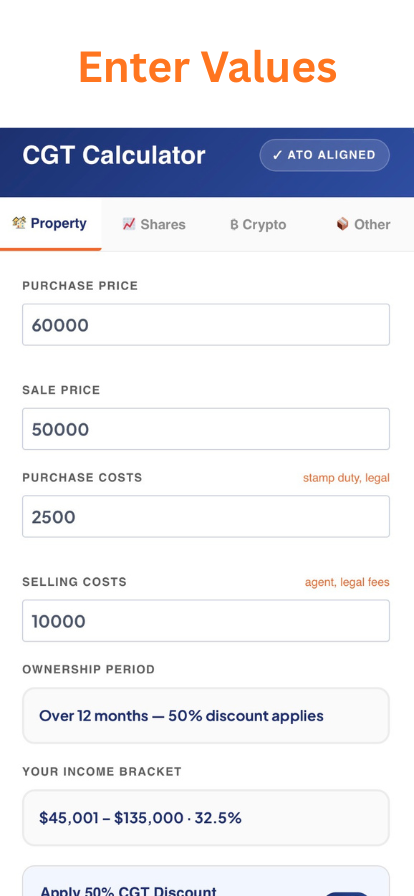
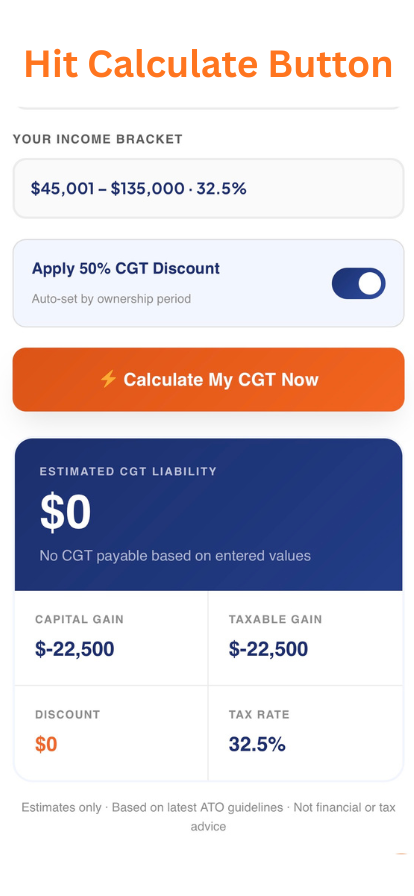
From your trade data to your estimated tax bill in four steps. Brokerage on both sides is handled automatically.
Enter Sale Price
The total amount you received from selling your shares or ETF units
Add Cost Base
Your purchase price plus buy-side brokerage. Sell-side brokerage reduces your proceeds.
Check Holding Period
Capital losses from this year or carried forward are deducted first. Then, if held 12+ months, the remaining gain is halved.
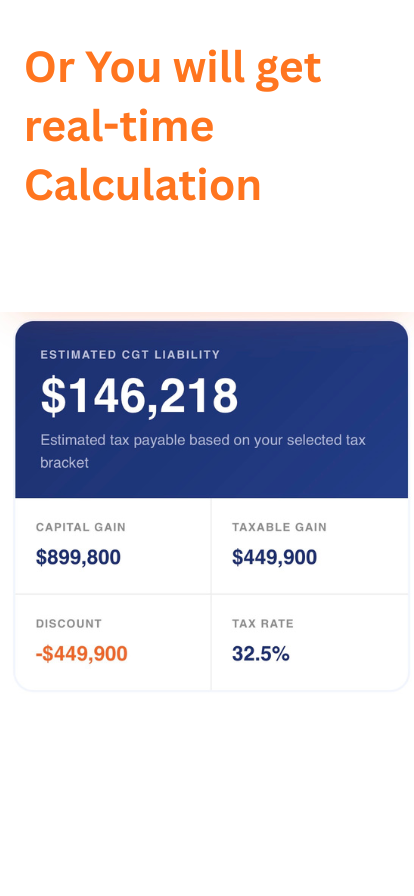
Calculate Your Tax
The taxable gain is added to your other income and taxed at your marginal rate. You can use Shares CGT Calculator above

What Counts in Your Shares Cost Base?
Counts
Purchase Price | Shares × price per share |
Buy-Side Brokerage | CommSec, Stake, SelfWealth etc. |
Sell-Side Brokerage | Deducted from sale proceeds |
FX Conversion Fees (US Shares) | Currency conversion costs |
Transfer Fees (some brokers) | If charged on purchase |
AMIT Cost Base Adjustments (ETFs) | Annual adjustments from fund |
Effect on your CGT | Reduces capital gain ↓ |
Quick example: 500 shares at $20 + $19.95 brokerage = cost base of $10,019.95. Sale at $15,500 less $19.95 brokerage = net $15,480.05. Capital gain = $15,480.05 − $10,019.95 = $5,460.10 (not $5,500). That $39.90 in brokerage saved you up to $18 in tax.
Doesn’t Count
Ongoing Platform Fees | Monthly/annual account fees |
Dividend Income | Taxed separately, not CGT |
Franking Credits | Not part of cost base |
Research & Subscription Fees | Not a cost base component |
Interest on Margin Loans | Deductible yearly, not CGT |
Portfolio Management Fees | Not a direct cost base item |
Effect on your CGT | No direct CGT reduction |
DRP parcels: Each dividend reinvestment creates a separate parcel with its own cost base (the share price on the DRP date) and its own 12-month clock. If you’ve been in a DRP for years, you could have dozens of separate parcels — each needs to be tracked separately.
ASX Share Sale with 50% CGT Discount
500 CBA shares bought in February 2022, sold in March 2025 after 3 years. Here’s exactly how the CGT is calculated. Shares CGT Calculator applied 50% discount Automatically.
PURCHASED (FEB 2022)
500 shares × $96.00 | $48,000.00 |
Buy brokerage (CommSec) | $29.95 |
Legal fees | $2,500 |
Total cost base | $48,029.95 |
SOLD (MARCH 2025)
500 shares × $145.00 | $72,500.00 |
Less sell brokerage | −$29.95 |
Net Sale Proceeds | $72,470.05 |
Net proceeds | $72,470.05 |
Less: Cost base | −$48,029.95 |
Capital gain | $24,440.10 |
50% discount applied (held 3 years ✓) | −$12,220.05 |
Taxable gain | $12,220.05 |
Tax at 32.5% (income ~$95k/yr) | $3,971.52 |
Total CGT Payable | $4,215.92 |
💡 Key insight: Without the 50% discount, if this investor had sold just one day before the 12-month mark the CGT would have been $8,431.84, more than double. The discount alone saved $4,215.92 in tax. It cost nothing except patience. Every share investor should know exactly where they sit relative to their 12-month purchase anniversary before deciding when to sell.
CGT Tax Rates for Shares
Capital gains from property are added to your regular income and taxed at your marginal rate. Here’s what that means at each bracket.
Taxable Income | Marginal Rate | Effective Rate (50% Discount) | Tax on $20,000 Gain |
|---|---|---|---|
$0 – $18,200 | 0% | 0% | $0 |
$18,201 – $45,000 | 19% | 9.5% | $1,900 |
$45,001 – $135,000 | 32.5% | 16.25% | $3,250 ← most investors |
$135,001 – $190,000 | 37% | 18.5% | $3,700 |
$190,001 + | 45% | 22.5% | $4,500 |
+ Medicare Levy | +2% | +$400 |
Here you can find latest information from official resource.
Important: Your capital gain is added on top of your regular income. If you earn $120,000 and make a $40,000 taxable gain, that pushes part of your income into the 37% bracket. Our calculator models this accurately but for large gains, a tax agent can model the exact bracket breakdown and advise on timing strategies to reduce stacking.