
Capital Loss Calculator Australia
See exactly how your capital losses offset capital gains, calculate your tax saving, and track what carries forward to future years. Covers shares, property, crypto, business assets & more. ATO-aligned.
📉 Capital Loss Calculator — Australia
Calculate your capital loss, how much tax it saves you, and what you can carry forward to future years. ATO-aligned.
How Capital Losses Work in Australia
A capital loss occurs when you sell a CGT asset for less than its cost base, the original purchase price plus all acquisition costs such as brokerage, stamp duty, and legal fees. Capital losses are one of the most powerful tools available to Australian investors for reducing tax.
Unlike business losses, capital losses cannot be applied against ordinary income such as salary, wages, dividends, or rent. They can only offset capital gains either in the same financial year or in future years. Importantly, capital losses must be applied before you apply the 50% CGT discount (Capital Loss Calculator figure out automatically), which means each dollar of loss eliminates two dollars of discounted gain.
💡 Key ATO Rule: If your total capital losses exceed your total capital gains for the year, the excess becomes a net capital loss. This carries forward indefinitely. There is no time limit and must be applied against capital gains in future years before you can apply the 50% discount or any other concession. Try out the Capital Loss Calculator above to get estimated values.
Capital losses can arise from shares falling in value, an investment property sold below purchase price, crypto assets sold at a loss, or any other CGT asset. Understanding how to apply them correctly and in the right order can save thousands in tax each year.
How to calculate CGT on Capital Loss Calculator
Step by step guide on Capital Loss Calculator.

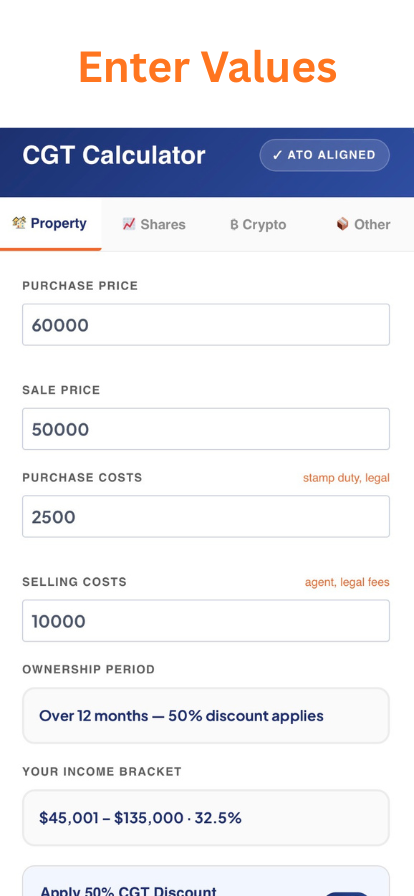
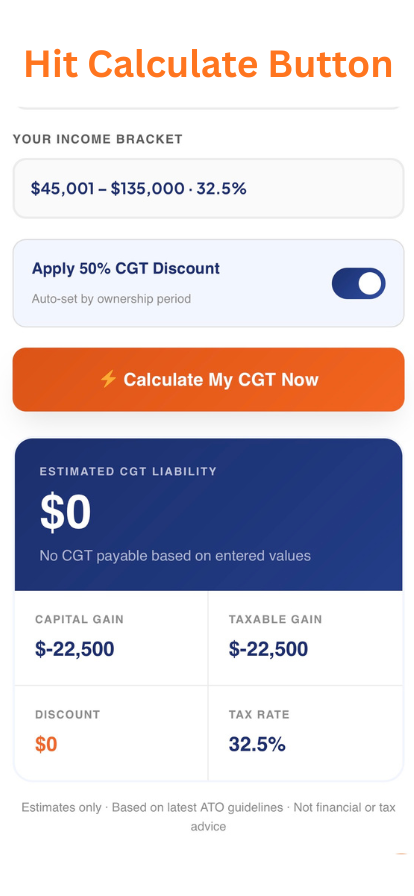
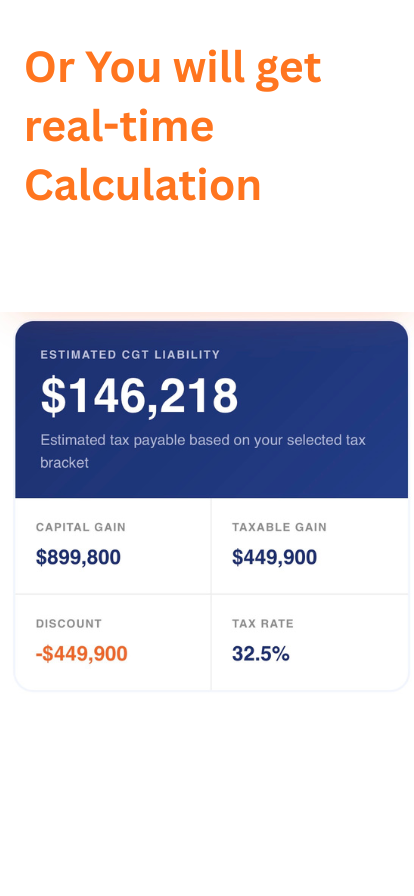
How Capital Losses Are Applied Step by Step
Work Out Each Capital Gain & Loss Separately
Calculate the gain or loss on every CGT asset disposed of during the financial year. Use the sale price minus the cost base (purchase price + all acquisition and disposal costs). Assets must have been acquired after 20 September 1985 to be subject to CGT.
Apply Carried-Forward Losses from Prior Years First
Any net capital losses from earlier financial years must be brought forward and applied against current-year gains. You must use prior-year losses before applying current-year losses against any remaining gains.
Apply Current-Year Capital Losses
Apply your current-year capital losses (like the $6,000 share loss above) against the remaining capital gain — before any discount or concession. This is where the ordering advantage is most powerful: each $1 of loss eliminates $1 of gross gain, saving you tax on $0.50 of post-discount gain.
Apply the 50% CGT Discount (if held 12+ months)
Only after all capital losses are applied do you halve the gain with the 50% CGT discount (for individuals and trusts who held the asset more than 12 months). This is the correct ATO order applying the discount before losses would give you a smaller benefit. Capital Loss Calculator determine discount automatically.
Carry Forward Any Remaining Unused Losses
If your total losses exceed your total gains for the year, the net capital loss carries forward indefinitely. Record it at label V in your supplementary tax return (question 18). There is no time limit — it remains available in all future years until fully used.
Wanna skip this out? Just give a shot to Capital Loss Calculator above.
Which Losses Can Be Used & Which Are Restricted
The CGT rate your SMSF pays depends entirely on which phase the fund is in at the time of sale.
✓ Fully Usable
Shares & ETFs
Capital losses on ASX shares, ETFs, managed funds, and international equities can fully offset any capital gains including property, crypto, and business assets.
✓ Fully Usable
Investment Property
Losses on investment properties sold below their cost base are fully usable against any other capital gain in the current or future years.
✓ Fully Usable
Cryptocurrency
The ATO treats crypto as a CGT asset. Losses from selling Bitcoin, Ethereum, or any other crypto can offset gains from any other CGT asset.
✓ Fully Usable
Business Assets
Capital losses on the sale of business assets (goodwill, equipment, intellectual property) offset any other capital gains subject to general CGT rules.
⚠ Restricted
Collectables
Losses on collectables (art, jewellery, antiques, rare stamps, coins) can only offset gains from other collectables. They cannot be applied against gains from shares, property, or crypto. They carry forward but only within the collectable category.
✕ Disregarded
Personal Use Assets
Losses on personal use assets (boats, furniture, electronics, cars used personally) are completely disregarded. They cannot be used to offset any capital gain. Even if you acquired the asset for more than $10,000, only capital gains are assessable — losses are still ignored.
All these things applied automatically on Capital Loss Calculator. Also you can get information through Official Source.
How to Use Capital Losses Strategically
Legal strategies investors use to reduce CGT liability using capital losses within ATO rules.
Strategy 1
Tax-Loss Harvesting Before 30 June
Review your portfolio before the end of the financial year (30 June). If you hold assets with unrealised losses and you also have realised gains this year, selling the loss-making assets before 30 June allows the loss to offset the current-year gain — potentially eliminating thousands in CGT. A loss crystallised on 1 July instead goes to next year.
⚠️ Wash Sale Risk: The ATO’s TR 2008/1 specifically targets arrangements where you sell for a loss and immediately repurchase the same asset to reinstate your economic position. If the ATO considers the sole purpose was tax minimisation, the loss may be disallowed.
Strategy 2
Apply Losses Before the 50% Discount
The ATO mandates that losses are applied before the 50% CGT discount — and this ordering is to your advantage. A $10,000 loss applied to a $50,000 gross gain (held 12+ months) leaves $40,000, discounted to $20,000 taxable. Without the loss, you’d have $25,000 taxable. Each $1 of loss saves you tax on $0.50 of post-discount income — amplifying the benefit.
Strategy 3
Carry Forward Strategically
If you have large carried-forward losses but expect a much bigger gain next year (e.g., a planned property sale), it may make sense to not realise additional losses this year — your existing carry-forward will be more valuable applied against a larger future gain. Timing when you realise gains matters as much as the amount.
Strategy 4
Match Losses to Discountable Gains
Where possible, apply capital losses against non-discountable gains first (assets held under 12 months, taxed at full rate). Then let the 50% discount work on your remaining long-term gains. The ATO allows you to choose which parcel of shares to sell — choosing high-cost parcels from your loss assets optimises this strategy.
Strategy 5
Record & Declare Every Year
You must declare your net capital loss on your tax return each year (label V, question 18) — even if you have no gains to apply it against. If you don’t declare it, you may lose the ability to use it in future years. Keep records of all purchase prices, sale prices, and costs indefinitely — the ATO can audit CGT events years later.
Still didn’t try Capital Loss Calculator? Get precised information.