
Crypto CGT Calculators
Sold Bitcoin? Swapped ETH? Earning staking rewards? This calculator gives you an instant, ATO-aligned estimate of your crypto tax no spreadsheet required.
₿ Crypto CGT Calculator — Australia
Calculate Capital Gains Tax on crypto trading, staking rewards & airdrops. ATO-aligned tax treatment. Free · No signup.
🚨 2026 Federal Budget Major CGT Changes for Crypto from 1 July 2027
From 1 July 2027, the 50% CGT discount on crypto will be replaced by cost-base indexation only real, above-inflation gains are taxed plus a 30% minimum tax rate. If you purchased crypto on or before 12 May 2026, you’re grandfathered: the 50% discount continues for gains accrued before 1 July 2027. Crypto purchased after 1 July 2027 uses the new indexation method from day one. This calculator reflects current 2025–26 rules. If you’re sitting on large unrealised gains, speak to your accountant about whether it makes sense to sell before the transition.
How the Crypto CGT Calculator Works
From your trade data to your estimated tax bill in four steps by using Crypto CGT Calculator. Trading fees, the 50% discount and capital losses are all handled automatically.
Choose Your Tax Type
Select the tab that matches your situation, Trading (CGT applies), Staking Rewards (ordinary income), or Airdrops (ordinary income). Each type is taxed differently, and this calculator handles all three correctly.
Enter Your Numbers in AUD
Enter your sale proceeds, purchase price and trading fees, all in AUD. If you originally bought in USD, convert at the ATO monthly exchange rate at each transaction date. This is a legal requirement not a choice.
Offset Losses & Apply Discount
Capital losses from other trades or previous years are deducted first. If you held for 12+ months the remaining gain is halved. The ATO requires losses to come before the discount this order is mandatory.
See Your Tax Estimate
Your taxable gain or income is added to your salary and taxed at your marginal rate. We include the 2% Medicare levy and give you a full line-by-line breakdown of exactly where the number comes from.
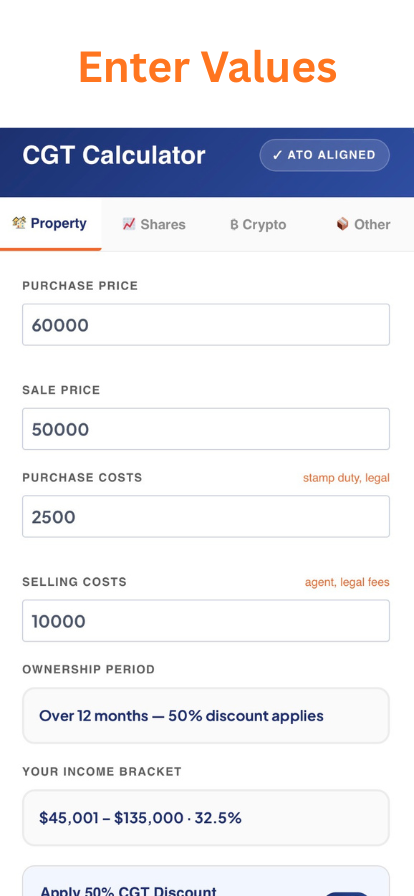
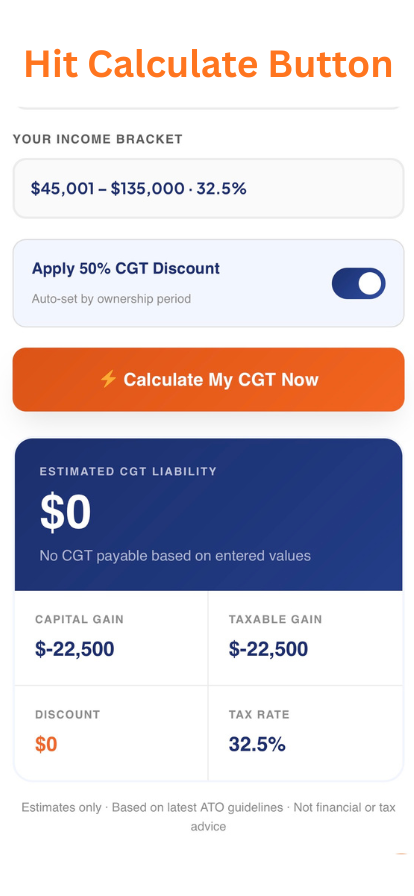
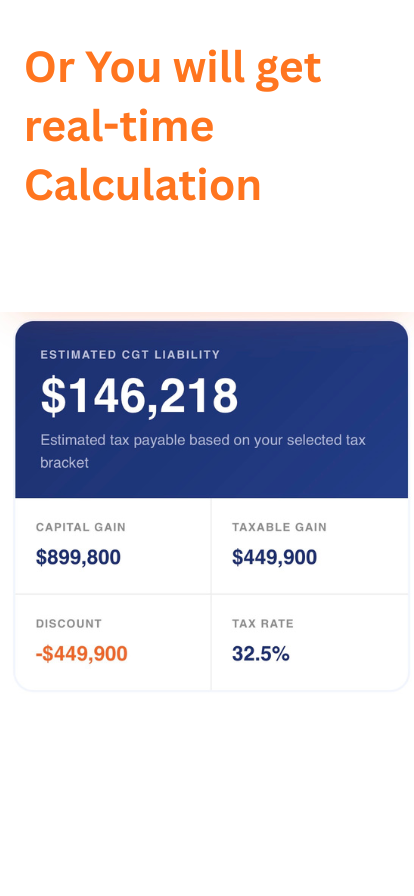
How to calculate CGT on Crypto CGT Calculator
Step by step guide on How to use Crypto CGT Calculator.

What Counts in Your Crypto Cost Base?
Counts
Purchase Price | AUD value at acquisition |
Exchange/Trading Fees | Buy-side commission |
Gas Fees (Ethereum) | Network fees on purchase |
FX Conversion Fees | USD → AUD conversion costs |
Transfer Fees (to cold storage) | If directly related to acquisition |
Effect on your CGT | Reduces capital gain ↓ |
Tip: Every buy-side fee you forget to include is extra tax you don’t owe. On a $50,000 purchase with 0.3% trading fees, that’s $150 in cost base you’re leaving on the table.
Doesn’t Count
Platform Subscription Fees | Ongoing account/service costs |
Staking Income Already Taxed | Taxed as income, not cost base |
Portfolio Tracker Costs | Not a direct acquisition cost |
Hardware Wallet Purchase | Not included in cost base |
Internet / Electricity Costs | Not deductible (unless business) |
Effect on your CGT | No direct CGT reduction |
Important: When you later sell staking rewards or airdrop tokens, your cost base is the FMV at the time you received them (when income tax was applied) not zero. This avoids double taxation.
Bitcoin Sale After 2 Years
Here’s exactly how a real Bitcoin trade is calculated for an Australian investor step by step, with the 50% discount applied correctly or you can use Crypto CGT Calculator above to get exact rate for data.
PURCHASED (January 2023)
0.5 BTC at $45,000 AUD | $22,500 |
Exchange fee (0.25%) | $56.25 |
Total Cost Base | $22,556.25 |
Sold (March 2025)
0.5 BTC at $90,000 AUD | $45,000 |
Exchange fee (0.25%) | $112.50 |
Total added to cost base | $44,887.50 |
Net proceeds | $44,887.50 |
Less: Cost base | −$22,556.25 |
Capital gain | $22,331.25 |
50% discount applied (held 2 years ✓) | −$11,165.63 |
Taxable gain | $11,165.62 |
Tax at 32.5% (income ~$85k/yr) | $3,628.83 |
Medicare levy 2% | $223.31 |
Total CGT Payable | $3,852.14 |
💡 Key insight: If this investor had sold just one day before the 12-month mark, the full $22,331 would have been taxable meaning a tax bill of about $7,700 instead of $3,852. The 50% discount alone saved nearly $4,000. For crypto investors, knowing your exact 12-month anniversary for each holding is one of the most valuable pieces of information you can track.
CGT Tax Rates for Crypto
Capital gains from property are added to your regular income and taxed at your marginal rate. Here’s what that means at each bracket.
Taxable Income | Marginal Rate | Effective Rate on Gain (50% Discount) | Tax on $20k Crypto Gain |
|---|---|---|---|
$0 – $18,200 | 0% | 0% | $0 |
$18,201 – $45,000 | 19% | 9.5% | $1,900 |
$45,001 – $135,000 | 32.5% | 16.25% | $3,250 ← most investors |
$135,001 – $190,000 | 37% | 18.5% | $3,700 |
$190,001 + | 45% | 22.5% | $4,500 |
+ Medicare Levy | +2% | +$400 |
Get latest information from official ATO site.
Income stacking matters: Your crypto gain sits on top of your salary. If you earn $120,000 and make a $40,000 taxable crypto gain, part of that gain will push into the 37% bracket. Our Crypto CGT Calculator handles this conservatively but for large gains, a tax agent can calculate the exact bracket split and recommend timing strategies that could reduce your bill.