Property & Real Estate

Property CGT Calculator Australia

Selling an investment property, rental property, or inherited home? Get your Property CGT Calculator in seconds. Fully aligned with the latest ATO guidelines.

50% Discount AppliedCost Base BuilderNo SignupCompletely Free

🏠 Property CGT Calculator — Australia

Enter your property details for an instant Capital Gains Tax estimate. Free · No signup · ATO-aligned.

Capital Gain
After 50% Discount
Estimated CGT Payable
Including 2% Medicare levy · Estimate only

⚠️ This is an estimate for general information only. It is not tax advice. Consult a registered tax agent for your personal circumstances.

🚨 2026 Federal Budget Major CGT Changes from 1 July 2027

The May 2026 Federal Budget announced the biggest change to Australian CGT in decades. From 1 July 2027, the current 50% CGT discount will be replaced by cost-base indexation (only real gains above inflation are taxed) plus a 30% minimum tax rate on those gains. Properties purchased on or before 12 May 2026 are grandfathered — the 50% discount continues to apply for pre-existing holdings. New residential builds from 1 July 2027 may choose whichever method delivers the lower tax. This calculator reflects current 2025–26 rules. Speak to your accountant about whether selling before 1 July 2027 makes sense for your property.

How it works

How the Property CGT Calculator Works

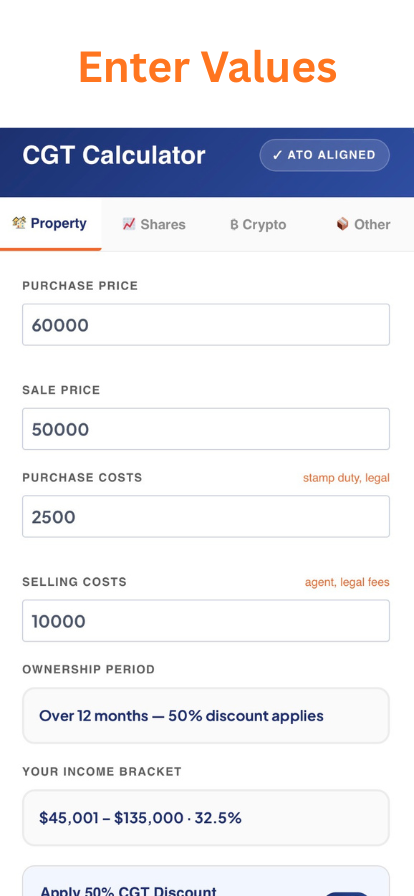
Four inputs, one result for your estimated tax bill in under a minute through Property CGT Calculator .

Enter Sale Price

What did you sell the property for? Include all proceeds from the sale.

Add Cost Base

Include stamp duty, legal fees, inspections, and improvements. This reduces your capital gain.

Check Holding Period

Held 12+ months? You get a 50% discount on your capital gain. Huge savings!

Calculate Your Tax

Your income determines your tax rate. We add the capital gain to your taxable income.

Calculating Guide

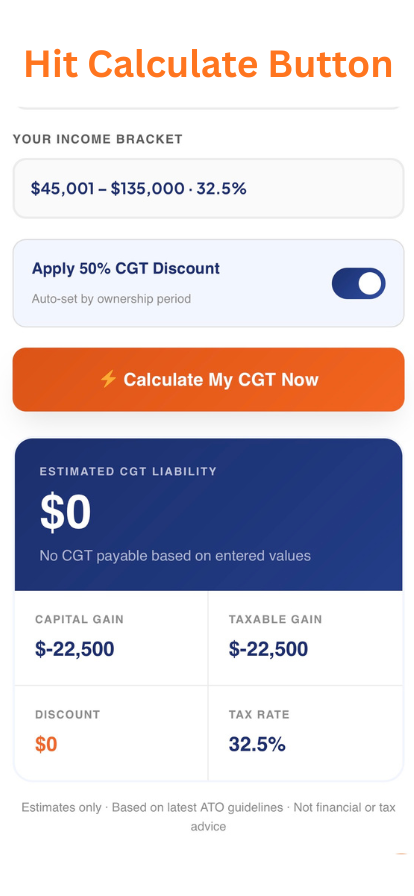
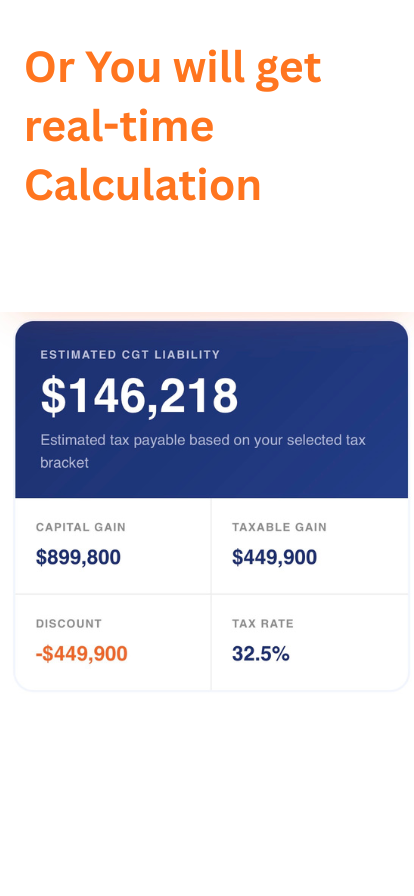
How to calculate Property CGT Calculator on TaxCalculatorAu.com

Here's the step by step guide on how to use Property CGT Calculator .

Cost Base Explained

What Counts in Your Cost Base?

Counts

Capital Improvement Test: Does it extend the building's life, add permanent value, or increase the property value? If yes, it counts.

Doesn't Count

Rule of Thumb: If it's something you deduct yearly (interest, management) or just maintains the property (paint, repairs), it's not part of cost base.

Real Example

Melbourne Investment Property for Property CGT Calculator

PURCHASED (2015)

Purchase price

Stamp duty (VIC)

Legal fees

$2,500

Starting cost base

Improvements (2015–2024)

Kitchen renovation (2018)

New roof (2020)

Bathroom renovation (2021)

Total added to cost base

Final cost base

Sale price (2024)

Capital gain (sale − cost base)

50% discount (held 9 years ✓)

Taxable capital gain

Tax at 32.5% + 2% Medicare

💡 Key insight: Those renovations added $63,000 to the cost base directly reducing the capital gain by $63,000 and saving the investor roughly $20,475 in tax (at 32.5%). Capital improvements aren't just good for resale value; they're one of the most effective ways to legally reduce your CGT bill. Keep every invoice. You can also put your values to Property CGT Calculator above.

Tax Rates

CGT Tax Rates for Property Sales

Capital gains from property are added to your regular income and taxed at your marginal rate. Here's what that means at each bracket.

$0 – $18,200

0%

0%

$0

$18,201 – $45,000

19%

9.5%

$9,500

$135,001 – $190,000

37%

18.5%

$18,500

$190,001 +

45%

22.5%

$22,500

+ Medicare Levy

+2%

+$1,000

Example: You earn $120,000 a year (32.5% bracket). You sell an investment property you've owned for 7 years with a $200,000 capital gain. After the 50% discount you have $100,000 taxable. CGT = $100,000 × 32.5% = $32,500, plus $2,000 Medicare = $34,500 total CGT. Your take-home: $700,000 sale minus $34,500 = $665,500.

You can also check latest information from official ATO site.

FAQs

Property CGT Calculator Common Questions

Generally no. Your principal place of residence (the home you actually live in as your main home) is exempt from CGT in Australia. You don't include it in your tax return and you pay nothing on the gain. The exemption only applies to your genuine main home a property you only nominally claim as PPOR while renting elsewhere doesn't qualify. If you've lived in the property for part of your ownership and rented it for the rest, a partial exemption applies, calculated proportionally by time.

Step 1: Work out your cost base purchase price plus stamp duty, legal fees, inspection costs, and capital improvements. Step 2: Subtract your cost base from your sale price (less selling costs like agent commission). Step 3: If you've owned the property for more than 12 months, halve the gain (50% discount). Step 4: Add that taxable gain to your other income for the year and apply your marginal tax rate. That's your CGT. Our Property CGT Calculator above does all of this automatically.

Yes! the 50% discount fully applies to all properties sold in the 2025–26 financial year, provided you've held the asset for more than 12 months. However, from 1 July 2027, the 2026 Federal Budget proposes replacing the 50% discount with cost-base indexation and a 30% minimum tax. Properties purchased on or before 12 May 2026 are grandfathered and the 50% discount continues for those assets. If you're planning a sale and this affects you, talk to your accountant soon, the window to lock in legacy treatment closes on 30 June 2027.

If you move out of your main residence and rent it out, you can continue treating it as your main residence for CGT purposes for up to 6 years. During this time, even if you're earning rental income, you can sell the property and claim the full main residence exemption means zero CGT. Requirements: the property must have been your genuine primary home first, you must not nominate another property as your main residence during this period, and the 6-year clock resets if you move back in before selling. This rule doesn't apply to foreign residents from 1 July 2020.

When you inherit property, you receive a "stepped-up" cost base, the property's market value at the date of the deceased person's death, not what they originally paid. CGT only applies to any growth in value after that inheritance date. This is a significant tax advantage: if a property was worth $800,000 when inherited and you later sell it for $850,000, your capital gain is only $50,000, not the full gain from the original purchase decades earlier. The main residence exemption may also apply to inherited property in certain circumstances to get advice specific to your situation.

Yes. Rental property follows the same CGT rules as investment property. Enter your purchase price, purchase costs, and capital improvements (such as renovations, structural work) as your cost base in Property CGT Calculator. Note: if you've claimed depreciation deductions on the rental property during your ownership than those amounts technically reduce your cost base meaning your capital gain at sale is higher than you might expect. Our general calculator doesn't account for depreciation add-back, so for rental property with significant depreciation claimed, we recommend using our dedicated rental property CGT calculator or speaking to your accountant.

A loss on a property sale is a capital loss, not an income loss. You can use it to offset capital gains you make in the same year (from other properties, shares, or crypto). If your losses exceed your gains, the unused capital loss carries forward indefinitely to offset gains in future years. Capital losses cannot be offset against regular income like wages or salary. Record every capital loss carefully you may be able to use it years from now.

For the 12-month discount test, the ATO uses the date you entered the contract not the settlement date for both the purchase and the sale. This is important: if you signed contracts to sell your property before the 12-month mark but settlement happens after, you don't get the discount. Conversely, if you signed contracts to buy in January 2023 but didn't settle until March 2023, your CGT clock starts from January 2023 contract date. Always check the contract date, not the settlement date.

The CGT itself is a federal tax the same rates and rules apply nationally. However, stamp duty (which forms part of your cost base) varies significantly by state. NSW and VIC have higher stamp duty rates than QLD or WA, which means buyers in those states have a higher cost base from day one, which slightly reduces their CGT. State land tax is a separate matter entirely and is not deductible for CGT purposes.

You report capital gains in your income tax return for the financial year in which the CGT event occurs . Tax is payable when you lodge that return typically by October 31 if you do it yourself, or later if you use a tax agent. There's no separate CGT return; it's included in your regular personal tax return under the capital gains section. You'll need to fill in the Capital Gains section and may also need to complete a Capital Gains Tax Schedule if your gains exceed certain thresholds.